For payfacs and PSPs
Aggregation economics only work if everything is programmatic.
Onboarding, branding, billing, settlement and support all have to be API surfaces rather than tickets, or the margin disappears into operations. Surfboard ships them as first-class endpoints: Service Providers for sub-aggregation, Multi-Merchant for shared infrastructure, Billing for granular pricing. All composable.
- API Onboarding, branding, billing, settlement
- N Sub-merchants under one integration
- 0 Manual steps in the happy path
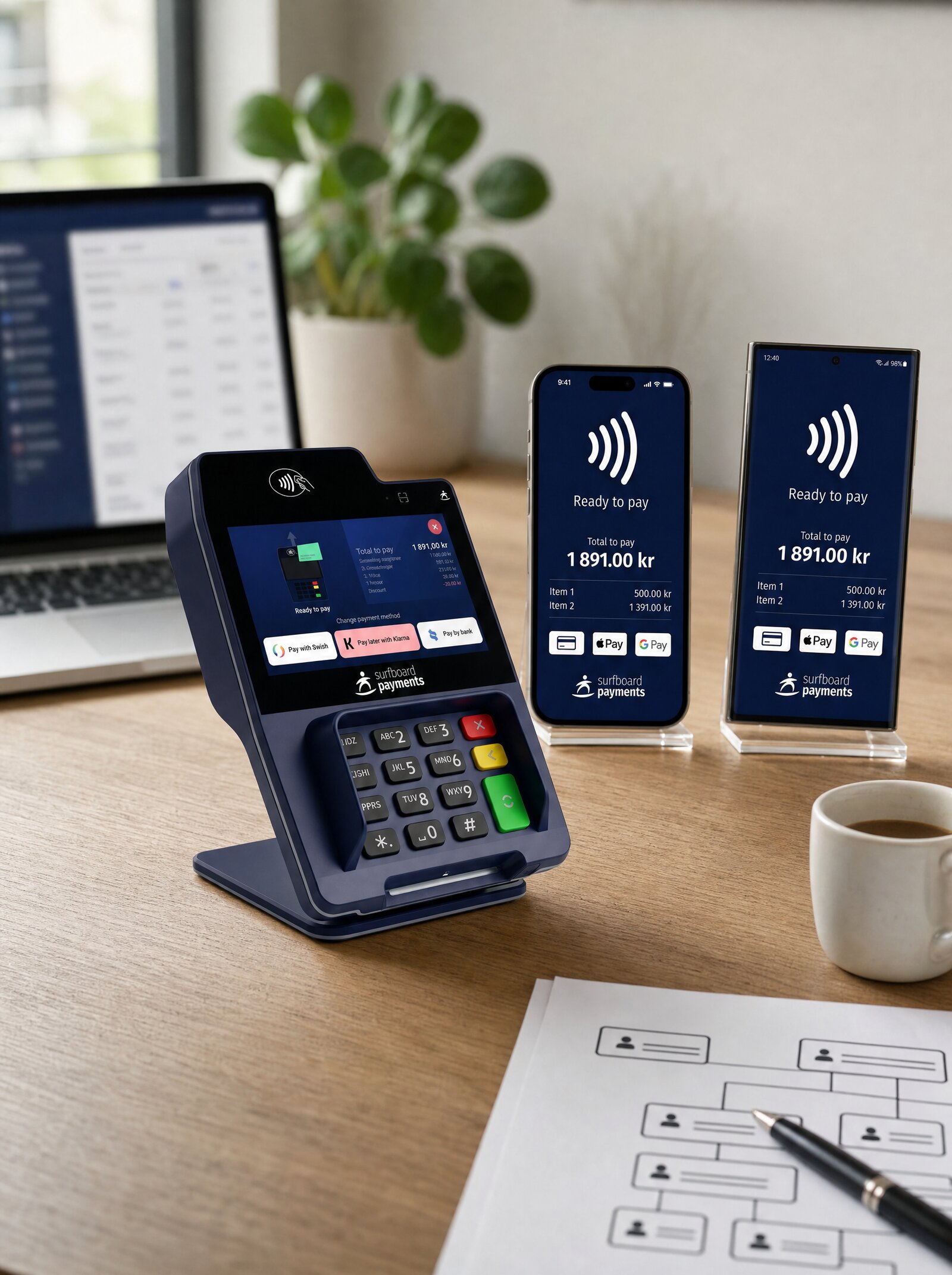
Built for Aggregation Economics
PayFac models work when acquisition cost stays low, sub-merchant margins compound, and operations don't grow linearly with merchant count. Surfboard's API surface is designed for that constraint set, programmatic onboarding, programmatic branding, programmatic billing, programmatic settlement, programmatic everything.
Service Providers API for the next layer of aggregation. Multi-Merchant API for shared-fleet workflows like food courts and event marketplaces. Logistics API for terminal procurement at scale. Notifications API for per-merchant report delivery without portal logins. All running on PCI DSS 4.0 multi-cloud infrastructure with 99.99% uptime.
Why PayFacs and PSPs choose Surfboard
Six reasons aggregation models pick Surfboard over building in-house or stitching together legacy vendors.
-
Programmatic Onboarding & KYB
PayFac economics live and die by acquisition cost per merchant. Surfboard's onboarding API runs KYB, creates merchants, configures stores, places terminal orders, and goes live, all without your team touching a ticket.
Current record: 5 hours from signup to first live transaction.
Pair with the AI API to generate per-merchant branding from the merchant's URL, instant, no design ops.
-
Service Providers API
PayFacs aggregating sub-providers, vertical integrators, or kiosk operators need a way to manage them programmatically. The Service Providers API covers the full lifecycle, create, track applications, fetch configs, manage approvals.
- Onboard third-party application providers under your umbrella
- Track application and approval status
- Per-provider configurations and routing
-
Multi-Merchant Terminal Sharing
Food courts, festival ecosystems, shared retail spaces, marketplace operators, all of them break the standard one-merchant-per-terminal model. The Multi-Merchant API lets one fleet serve many independent merchants while preserving per-merchant settlement, branding, and reporting.
Built into the platform as a first-class API, not a workaround.
-
Per-Merchant Pricing and Margin Control
PayFac economics demand granular pricing. The Billing API lets you define plans per merchant, per store, or per terminal, including IC++ pricing, usage-based charges, and tiered structures that adjust automatically with volume.
- Custom plans per merchant segment
- IC++ for transparency-focused buyers
- Usage-based charges for value-add features
- Automated invoicing and settlement deduction
-
Settlement and Reporting at Scale
Per-merchant daily or monthly settlement reports. SFTP delivery for ERP integration. Adjustments ledger for tip and surcharge audit. Stable IDs and immutable URLs designed for the data-pipeline scale PayFacs operate at.
Pair with the Notifications API to push reports to merchants automatically, no portal logins, no support tickets.
-
White-Label Across Every Sub-Merchant
Each merchant in your portfolio gets their own branded experience, terminals, hosted checkout, merchant portal, receipts, identification prompts. Branding cascades from PayFac default → merchant override → store override → terminal override.
Deploy thousands of branded merchant experiences without a design ops team.
The aggregation primitives PayFacs need
Each one is reachable from the integration you have already written. Nothing below is a separate product to buy.
Build it yourself
Step-by-step developer guides for everything on this page.
Create a merchant application through the Partner API and hand the merchant a prefilled web KYB link. Registry lookup, automatic business classification, people and signing, application status, and store setup.
Read guide In-store · GuideSet up shared payment terminals for multiple merchants using the Multi-Merchant Group API. Ideal for food courts, events, and co-located businesses.
Read guide Online · GuideRetrieve settlement reports, view adjustments, manage merchant charges, and register customer profiles for reconciliation and billing.
Read guide Online · GuideReceive real-time event notifications via webhooks. Subscribe to order, payment, logistics, and merchant application events with automatic retries and signature verification.
Read guide