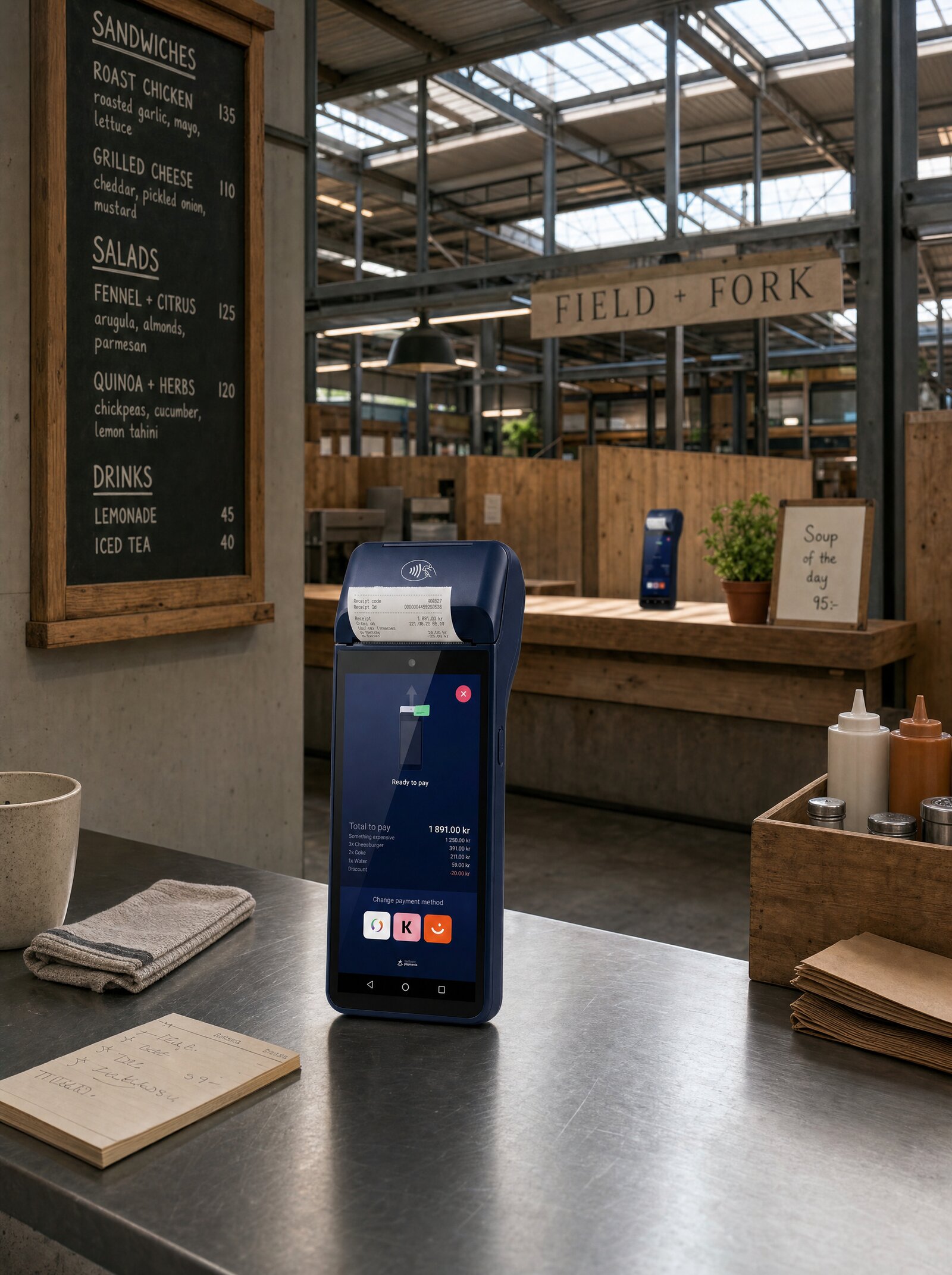
One Fleet. Many Merchants. Clean Settlement.
Multi-merchant groups let one shared terminal fleet serve many independent merchants, with each merchant keeping their own branding, pricing, settlement, and reporting. Built for food courts, festivals, pop-ups, and shared retail. Paired with the Service Providers API for onboarding third-party application providers at scale.
Shared Hardware, Independent Settlement
Most payment platforms force a one-merchant-per-terminal model. That breaks the moment you have a food court, a festival, a shared kitchen, or a pop-up marketplace. Surfboard's multi-merchant groups invert the assumption, the terminal is shared infrastructure; the merchants behind it stay fully independent.
Each merchant tagged into a group keeps everything that makes a merchant a merchant: their own branding, their own pricing, their own settlement schedule, their own reporting. The group is a routing layer, not a financial entity. Clean for operators, clean for merchants, clean for compliance.
Built for marketplace partners
ISVs running food halls, festival operators, mall management companies, and service-provider platforms all need this primitive. Surfboard ships it as a first-class API, not as a special-case workaround. One POST creates the group; merchants get tagged in; the same terminals start routing.
How Multi-Merchant Works
Create a multi-merchant group
POST /partners/:partnerId/multi-merchant
{
  "country": "SE",
  "zipCode": "11122",
  "name": "Hötorget Food Court"
}

// Response
{
  "status": "SUCCESS",
  "data": {
    "applicationId": "81376ad8ebedf80310",
    "merchantId": "81660b596c7fd0000e",
    "storeId": "81660b59434440030f"
  }
}Tag merchants into the group
// Add an existing merchant to the group
PUT /partners/:partnerId/merchants/:merchantId/multi-merchant-group
{
  "multiMerchantId": "81660b596c7fd0000e"
}

// Remove the merchant from the group
DELETE /partners/:partnerId/merchants/:merchantId/multi-merchant-groupOne terminal serves every merchant in the group
What you can build
Multi-merchant groups and service providers cover a class of partner workflows that single-merchant platforms simply can't model. Here's where this matters.
1. Food Courts & Shared Kitchens
Ten restaurants in one hall. One queue. One terminal at the order point. Each transaction settles to the right kitchen, without ten separate hardware fleets, ten cabling jobs, or ten reconciliation reports.
- One terminal, multiple settling merchants
- Independent branding and pricing per merchant
- Per-merchant settlement and reporting preserved
Perfect for:
- Food halls and ghost-kitchen operators
- Pop-up markets and food truck rallies
- Mall-based queueing concepts
2. Festival & Event Marketplaces
Festivals run dozens of independent vendors. The festival operator owns the terminals and the customer experience; each vendor settles independently. Multi-merchant groups model this exactly, one fleet, many beneficiaries.
Pair with the Notifications API for real-time settlement breakdowns to vendors after each event day.
3. Service Provider Applications
The Service Providers API lets partners onboard third-party application providers, POS systems, kiosk operators, vending vendors, under their own partner umbrella. Track application status, fetch service provider configs, and manage the full provider lifecycle.
- Onboard service providers programmatically
- Track application and approval status
- Fetch provider configurations per merchant or partner
4. Coworking & Shared Retail
A retail space that hosts multiple independent brands, pop-up stores, makers' markets, art galleries with consigned artists. Multi-merchant groups give the host one terminal fleet while preserving each brand's identity, settlement, and reporting.
5. Mobile & Pop-Up Networks
A partner running a network of pop-up vendors at sports events, summer markets, or seasonal locations. Issue terminals to the network operator, tag participating merchants in, and let the same hardware travel between events without any per-event reconfiguration.
6. Clean Settlement Per Merchant
The shared terminal is just hardware. Settlement is always merchant-by-merchant. Each merchant in a group sees their own Reporting API output, their own Billing plan applied, their own payouts, their own statements. The group is a routing concept, not a financial one.
Compliance and audit trails stay clean even when the underlying device fleet is shared.
Two APIs, one orchestration story
Create a group, list the groups under a partner, and tag merchants in and out. Any number of merchants can join. The terminals registered to the group serve every member.
Settlement, reporting, and branding stay independent per merchant.
Five endpoints to onboard service providers, POS systems, kiosk operators, vending vendors, under your partner umbrella. Track application status, fetch configs, manage the lifecycle.
For partners building their own ecosystem of integrators.
Composes with the rest of the platform
Each merchant in a multi-merchant group still pulls its own settlement reports through the Reporting API, gets its own branding through the Branding API, and runs against its own Billing plan. The group is a thin coordination layer, the underlying primitives don't change.
Marketplace and shared-fleet workflows shouldn't require a different platform. With Surfboard they don't.
Create your first multi-merchant group
The Multi-Merchant API creates groups and tags merchants in and out. The Service Providers API adds five endpoints for third-party onboarding. Together they cover marketplace operators, festival ecosystems, food courts, and partner-of-partner integrations.
// Create a multi-merchant group for a food court
  POST /partners/:partnerId/multi-merchant
  {
    "country": "SE",
    "zipCode": "11122",
    "name": "Hötorget Food Court",
    "email": "ops@hotorget.example"
  }

  // Onboard a third-party Service Provider
  POST /partners/:partnerId/service-providers
  {
    "name": "Acme Kiosks",
    "type": "KIOSK_OPERATOR",
    "country": "SE"
}Build it yourself
Step-by-step developer guides for everything on this page.
Set up shared payment terminals for multiple merchants using the Multi-Merchant Group API. Ideal for food courts, events, and co-located businesses.
Read guide Online · GuideCreate a merchant application through the Partner API and hand the merchant a prefilled web KYB link. Registry lookup, automatic business classification, people and signing, application status, and store setup.
Read guide In-store · GuideRegister a terminal to a store before it can take payments or receive a partner POS app. Covers rotating codes, QR/registration links, pre-shipped codes, and in-app registration for SoftPOS.
Read guide Online · GuideCreate, update, verify, and manage in-store and online stores using the Surfboard Payments Store APIs.
Read guide