Top API Payment Features ISVs Need in 2026
The seven API capabilities that separate a fast payment integration from a six-month onboarding project, and how the main platforms compare on unified channel coverage, SoftPOS and white-label branding.
Most payment integrations start the same way. You open the docs. The docs are a 400-page PDF last updated in 2021. There are three SDKs, none of which match the API version your account was provisioned on. You email support. Support replies in four business days with a link to the same PDF.
If you are an ISV embedding payments into your product, integration speed is not a nice-to-have. Every week you spend wrestling with a payment provider's API is a week you are not shipping your core product. Surfboard Payments built its platform to kill that workflow.
This article covers the seven API features that matter most when evaluating an API payment platform for embedded in-store and SoftPOS payments. No marketing abstractions. Just the technical capabilities that separate fast integrations from six-month onboarding projects.
Quick guide: 7 API payment platform features for ISVs
- Unified API for all payment channels: The foundation for in-store, online, and SoftPOS payments through one integration
- White-label branding: Full control over merchant-facing terminals, receipts, and checkout pages
- Fast merchant onboarding: Self-serve activation with minutes-to-live timelines
- SoftPOS and Tap to Pay support: Turn smartphones into payment terminals without dedicated hardware
- Acquirer-agnostic routing: Freedom to switch processors without re-integrating
- Remote terminal management: Push updates, configure settings, and monitor devices via API
- Offline payment resilience: Process transactions when networks fail with automatic sync
How we chose the best API payment features for ISVs
We evaluated API payment platforms based on what ISVs actually need in production. Integration speed, developer experience, and time-to-revenue drove our criteria. No feature made this list unless it directly reduces integration complexity or accelerates merchant activation.
- Single API coverage: Does one integration handle in-store terminals, SoftPOS, and online checkout? Fragmented APIs mean fragmented codebases.
- Onboarding velocity: How fast can a merchant go from signup to first live transaction? Days or hours separates modern platforms from legacy providers.
- White-label depth: Can ISVs brand every customer touchpoint? Terminals, receipts, checkout pages, and merchant portals should match your product.
- Hardware flexibility: Does the platform support SoftPOS alongside traditional terminals? Merchants need options without multiple integrations.
- Processor independence: Can you switch acquirers without rebuilding your integration? Lock-in kills negotiating power and limits geographic expansion.
- Remote management APIs: Can you configure terminals, push updates, and monitor fleet health programmatically? Manual terminal management does not scale.
- Offline capability: What happens when the network drops? Payment downtime means lost revenue for your merchants.
The 7 API payment platform features ISVs need
1. Surfboard Payments: Unified API for in-store, online, and SoftPOS
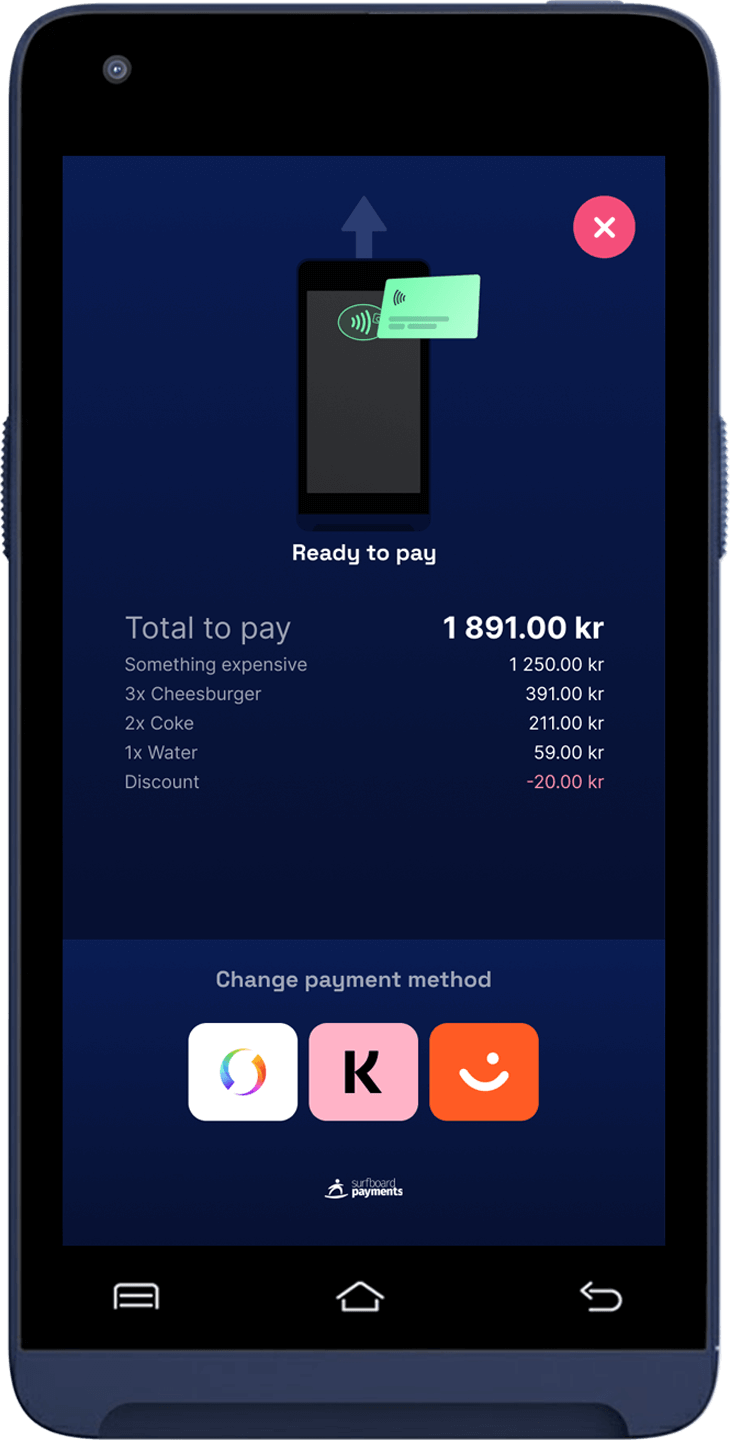
Surfboard Payments gives you a single REST API that covers in-store terminals, online checkout, SoftPOS (Tap to Pay on iPhone and Android), and unattended devices. That is not a marketing abstraction. It is the literal architecture.
The same payment application runs on EMV hardware and SoftPOS devices. Whether the transaction happens on a SurfPrint Pro at a restaurant counter or through a hosted payment page on a customer's phone, the API calls are identical. One integration, all channels.
Surfboard Payments eliminates the multi-vendor reconciliation problem ISVs face when piecing together separate in-store and online providers. You get unified tokenization across channels, meaning a card saved online works at a physical terminal. You get unified settlement and reporting. You get one payout to your merchants regardless of payment method.
Surfboard Payments features
- One API for all channels: In-store, online, SoftPOS, and unattended payments through the same endpoints. No separate integrations per channel.
- Cross-channel tokenization: Cards tokenized online work at physical terminals. Customer recognition spans every touchpoint.
- OpenAPI specification: Point your AI coding assistant at the spec and get clean, current context about endpoints, authentication, and object schemas.
- Webhook-driven architecture: Real-time event notifications with automatic retries, delivery signatures, and full transaction context.
- Multi-cloud infrastructure: Runs on Google Cloud, AWS, and Azure with 99.99% uptime. PCI DSS 4.0 certified.
- Sandbox access: Get test credentials instantly. No sales call required to start building.
Surfboard Payments pros and cons
Pros:
- Single integration covers in-store, online, and SoftPOS without separate codebases
- Acquirer-agnostic architecture means no processor lock-in
- Current record is 5 hours from signup to a live terminal processing real transactions
Cons:
- Currently active in 12 European markets, with more regions planned
- Full documentation is in English, with localization expanding
- Advanced features like AI-generated branding may require additional configuration
2. Checkout.com: Multi-method online payment processing
Checkout.com offers a unified API for online payment acceptance with coverage across cards, digital wallets, and local payment methods. The platform handles payment processing, fraud detection, and payouts through one integration for e-commerce focused businesses.
The API supports multiple payment methods including cards, Apple Pay, Google Pay, and regional options. Checkout.com processes transactions in 150+ currencies with local acquiring in key markets.
Checkout.com features
- Multi-method acceptance: Cards, wallets, and local payment methods through one API
- Global currency support: Processes transactions in 150+ currencies
- Fraud detection: Machine learning models for transaction screening
Checkout.com pros and cons
Pros:
- Single API handles multiple payment methods for online transactions
- Local acquiring in key markets can improve authorization rates
- Webhook notifications for transaction events
Cons:
- Primarily focused on online payments, in-store requires additional integrations
- Enterprise pricing model may require volume commitments
- SoftPOS capabilities are limited compared to dedicated in-store platforms
3. Worldpay: Large-scale enterprise payment processing
Worldpay processes payments across 146 countries with support for 300+ payment methods. The platform handles high transaction volumes for enterprise merchants and offers both online and in-store processing capabilities through its FIS infrastructure.
The platform includes tools for fraud management, chargeback handling, and cross-border transaction optimization. Worldpay serves large enterprises with complex payment requirements across multiple geographies.
Worldpay features
- Global reach: Payment processing in 146 countries
- 300+ payment methods: Cards, wallets, and local payment options
- Enterprise infrastructure: High-volume transaction processing
Worldpay pros and cons
Pros:
- Extensive global coverage across 146 countries
- Supports 300+ payment methods for international expansion
- Enterprise-grade infrastructure for high transaction volumes
Cons:
- Complex integration process that may take months for full deployment
- Enterprise focus means less attention to ISV-specific requirements
- Limited white-label customization for partner branding
4. Square: Combined POS and payment processing
Square offers an integrated ecosystem combining point-of-sale software with payment hardware and processing. The platform targets small to medium businesses with a focus on simplicity and quick setup for retail and food service environments.
Square provides SDKs for mobile and web applications alongside proprietary hardware. The Reader SDK allows embedding payment acceptance into custom iOS and Android applications for businesses building their own POS systems.
Square features
- Integrated ecosystem: POS software, hardware, and processing in one package
- Reader SDK: Embed payment acceptance in custom mobile applications
- Quick setup: Merchants can start accepting payments rapidly
Square pros and cons
Pros:
- Unified POS and payment system reduces vendor complexity
- Mobile SDKs for iOS and Android custom applications
- Suitable for small businesses wanting turnkey solutions
Cons:
- Limited white-label options for ISV branding requirements
- Primarily tied to Square hardware ecosystem
- Geographic availability focused on select markets
5. PayPal Zettle: Mobile-first payment terminals
PayPal Zettle offers card readers and POS solutions for small businesses, combining mobile payment acceptance with PayPal's merchant services. The platform includes Bluetooth card readers that pair with smartphones and tablets for in-person payments.
Zettle integrates with PayPal's broader ecosystem including PayPal wallet acceptance and working capital offerings. The platform focuses on simplicity for small merchants entering physical retail.
PayPal Zettle features
- Mobile card readers: Bluetooth devices that pair with smartphones
- PayPal integration: Accept PayPal alongside card payments
- Small business focus: Quick setup for new merchants
PayPal Zettle pros and cons
Pros:
- Integration with PayPal merchant ecosystem
- Simple setup process for small businesses
- Mobile-first approach for flexible acceptance
Cons:
- Limited enterprise-grade terminal options
- API capabilities are less extensive than developer-first platforms
- White-label customization is restricted
6. SumUp: Portable payment hardware
SumUp offers compact payment terminals for mobile merchants and small businesses. The product line includes Air card readers, Solo terminals, and the SumUp Point mobile device. The platform targets micro-merchants and mobile sellers.
SumUp processes card payments through its proprietary terminals with a focus on portability and ease of use. The platform is available across Europe, North America, and Latin America.
SumUp features
- Portable terminals: Compact devices for mobile merchants
- Multi-region availability: Active in Europe, Americas, and APAC
- Simple onboarding: Quick merchant activation
SumUp pros and cons
Pros:
- Portable hardware suitable for mobile businesses
- Available across multiple regions
- Quick merchant setup process
Cons:
- Limited API depth for ISV integrations
- No SoftPOS option for smartphone-based acceptance
- White-label branding options are minimal
7. Payroc: ISV-focused payment partnerships
Payroc positions itself as a payment partner for independent software vendors with a focus on the ISV lifecycle. The platform offers integrated payment solutions with an emphasis on support and onboarding processes tailored to software companies.
Payroc provides cloud-based payment infrastructure with a partnership model designed for ISVs embedding payments into vertical software. The company emphasizes relationship management alongside technical integration.
Payroc features
- ISV partnership model: Dedicated support for software companies
- Cloud infrastructure: Centralized payment processing
- Revenue sharing: Monetization options for ISV partners
Payroc pros and cons
Pros:
- Focus on ISV partnership and support
- Revenue sharing models for payment monetization
- Onboarding support tailored to software companies
Cons:
- Geographic focus primarily on North America
- SoftPOS capabilities may require additional vendors
- Hardware options are less extensive than dedicated terminal providers
Comparison table: API payment platform features for ISVs
| Platform | Unified In-Store + Online API | SoftPOS Support | White-Label Branding |
|---|---|---|---|
| Surfboard Payments | ✓ | ✓ iOS + Android | ✓ Full |
| Checkout.com | Online focus | Limited | Partial |
| Worldpay | Separate integrations | ✗ | Limited |
| Square | Partial | ✗ | Limited |
| PayPal Zettle | Separate integrations | ✗ | ✗ |
| SumUp | In-store focus | ✗ | ✗ |
| Payroc | Partner dependent | Partner dependent | Partial |
What makes a unified payment API critical for ISVs?
A unified API means one integration handles all payment channels. In-store terminals, online checkout, SoftPOS, and unattended devices all run through the same endpoints. You build once. You maintain once. You debug once.
The alternative is painful. Separate integrations for in-store and online payments create separate codebases. Different authentication flows. Different webhook schemas. Different error handling. Every channel becomes its own project with its own maintenance burden.
For ISVs shipping vertical software, payment complexity is a distraction from core product development. A unified API lets you offer omnichannel payments to your merchants without omnichannel engineering overhead.
Why does SoftPOS matter for embedded payment integrations?
SoftPOS turns any NFC-enabled smartphone into a payment terminal. No dedicated hardware. No upfront costs for merchants testing new locations. No waiting for terminal shipments.
For ISVs, SoftPOS expands your addressable market. Merchants who would not commit to hardware terminals can start accepting payments immediately on devices they already own. Food trucks, market stalls, service providers doing house calls. Anywhere a smartphone goes, payments can follow.
Surfboard Payments supports Tap to Pay on iPhone and CheckoutX for Android. The same API that handles hardware terminals handles SoftPOS. No separate integration. No additional vendor relationships.
Why Surfboard Payments is the API payment platform for ISVs
Surfboard Payments solves the fragmentation problem that drains ISV engineering time. One API covers in-store, online, SoftPOS, and unattended payments. One integration scales across channels without rebuilding.
The platform is acquirer-agnostic. You are not locked into a single processor. Switch acquirers, expand into new markets, negotiate better rates. Your integration stays the same. That is not a marketing abstraction. It is the literal architecture.
Surfboard Payments delivers fast merchant onboarding that matches the speed ISVs need. Our current record is 5 hours from signup to a live terminal processing real transactions. That is not a best-case hypothetical. It happened.
Full white-label branding covers terminals, receipts, checkout pages, and merchant portals. Your merchants see your brand. Surfboard Payments operates in the background. Developer documentation is current, the sandbox is instant, and support responds in hours.
Start building with Surfboard Payments. Sign up at the Developer Portal. You get sandbox credentials instantly. No sales call required to start building.
FAQs about API payment platform features for ISVs
What is an API payment platform?
An API payment platform is a service that lets ISVs embed payment acceptance into their software through programmable interfaces. Instead of building payment infrastructure from scratch, you send API requests to a payment provider that handles authorization, settlement, compliance, and fraud detection.
Surfboard Payments offers a REST API covering in-store terminals, online checkout, and SoftPOS through the same endpoints.
What is the difference between SoftPOS and traditional payment terminals?
Traditional payment terminals are dedicated hardware devices that accept card payments. SoftPOS turns existing smartphones and tablets into payment terminals using their built-in NFC readers for contactless acceptance. No additional hardware required.
Surfboard Payments supports both. The same API handles hardware terminals like SurfPrint Pro and SoftPOS on iOS and Android.
Why do ISVs need white-label payment branding?
White-label branding lets ISVs maintain a consistent brand experience across their product. When merchants use your software and your payment integration, they should see your brand on terminals, receipts, and checkout pages.
Without white-label options, your payment provider's brand appears at the point of transaction. That breaks the user experience you built.
How long does a payment API integration take?
Integration time varies by platform and use case. Legacy providers with fragmented APIs and manual onboarding can take months. Modern platforms with unified APIs and developer-first documentation can ship in days.
Surfboard Payments built its developer experience around speed. Sandbox access is instant. Documentation includes working code examples. The current record is 5 hours from signup to live transactions.
What does acquirer-agnostic mean for payment platforms?
Acquirer-agnostic means the platform is not locked to a single payment processor. You can switch acquirers, add new ones for specific markets, or negotiate better rates without rebuilding your integration.
Surfboard Payments connects to multiple acquirers through one API. Your code stays the same. Processing relationships are flexible. That is how you avoid lock-in.